EVERYTHING IS DIRT
Everything is Dirt is an ongoing material research project that began as my Master of Architecture manifesto in February 2026. Over the months that followed, it evolved into a broader exploration of the theoretical ideas that ground my interests in architecture, earth systems, cosmology, philosophy, and spirituality. Presented here is the manifesto in its original form. At the bottom of this page, you'll also find a link to a digital version of the original physical manifesto, which includes visual research compiled over several years. Unless otherwise noted, all writing, drawings, photography, and material research presented here are my own.
Everything is dirt.
Buildings, cities, technologies and bodies are composed of the same matter reorganised through natural and mechanical processes. Dirt is not simply soil. It is matter in transition: rock becoming sediment, timber becoming compost, buildings becoming rubble and bodies becoming earth. It is the medium through which materials are transformed and reincorporated into larger ecological systems. Dirt is not the opposite of civilisation, but one of its fundamental conditions. Every city, building and technology ultimately emerges from, and returns to, the earth.
This understanding challenges distinctions between nature and culture, human and non-human, subject and object. Such categories can be useful, but they often obscure the material continuities that connect all things (Latour, 1993). Matter moves continuously between states, scales and systems through processes of growth, decay, extraction, construction and transformation. The history of matter is therefore also the history of architecture, civilisation and humanity itself.
Yet contemporary architecture often appears increasingly detached from these realities. Buildings become surfaces, branding exercises and rendered spectacles. Architecture operates through a denial of extraction, labour, entropy, decay, geology and time. Economies of scale, globalisation, mass production and façade-driven design practices conceal the material reality present within all things. They flatten difference, remove tactility and suppress evidence of growth, weathering, friction and age.
Materials are processed to the point of abstraction, stripped of their natural intelligence and beauty. This mode of making reinforces a culture of superficiality detached from time and place, limiting our engagement with the material systems that sustain us.
This manifesto argues for a more grounded architectural practice: one less over-processed, less image-driven and less detached from earth systems. It calls for an architecture that foregrounds material truth, entropy, atmosphere and planetary thinking whilst still engaging technology in a considered way.
Through a survey of material origins, architectural history, contemporary philosophy and emerging modes of practice, this project explores how architecture might reconnect itself to the material systems from which it emerges. Borrowing from geological surveys, museum collections, urban scans, satellite imagery, bio-material research and architectural precedents, it maps the origins, transformations and eventual decay of matter itself. The challenge is not to reject technology, but to reconnect it to the material conditions from which it emerges.
MATERIAL ORIGINS
Let us start at the beginning. Of everything.
The most widely accepted scientific theory for the origin of the universe is the Big Bang. It proposes that all matter, energy, space and time can be traced to a singular event approximately 13.8 billion years ago (Hawking, 1988). From this emerged hydrogen and helium, then stars, planets and galaxies. Within the cores of stars, heavier elements were forged before being scattered across the universe through stellar collapse and explosion (Sagan, 1980).
Since then, matter has existed in a constant state of transformation. Cosmic dust condenses into planets. Mountains rise and erode. Forests grow and decay. Rivers carve valleys. Matter is continually broken apart, reorganised and recombined into new formations. The universe is not composed of static objects, but of dynamic processes operating across vast scales of time and space.
Around 4.5 billion years ago, our solar system formed (NASA, n.d.). Earth, a product of this cosmic dance, gradually settled into a state capable of supporting life. Life itself emerged through complex interactions between geology, chemistry, water, atmosphere and energy. Over billions of years, simple organisms evolved into increasingly complex forms. Humans are one expression of this ongoing material history.
Every mountain, tree, animal, building, computer and human body is composed of matter forged within stars billions of years ago (Sagan, 1980). The distinction between natural and artificial objects is therefore less absolute than it first appears. Both emerge from the same material field through different processes of organisation and transformation.
For most of human history, our relationship with matter was highly direct. We lived from the land and built with the materials closest at hand (Ingold, 2013). As hunter-gatherer communities gave way to agrarian settlements, towns and increasingly complex systems of trade and commerce, that relationship became progressively mediated, despite remaining fundamentally dependent natural systems. Harari, 2014).
Wood and stone gave way to bronze and glass, then iron, steel and concrete (Mumford, 1961). Materials travelled greater distances. Supply chains lengthened. Extraction, manufacture and construction became increasingly specialised and abstract (Sennett, 2008). Gradually, the origins of the things around us became less visible as materials, labour and production were separated from the places in which they were consumed (Frampton, 1983).
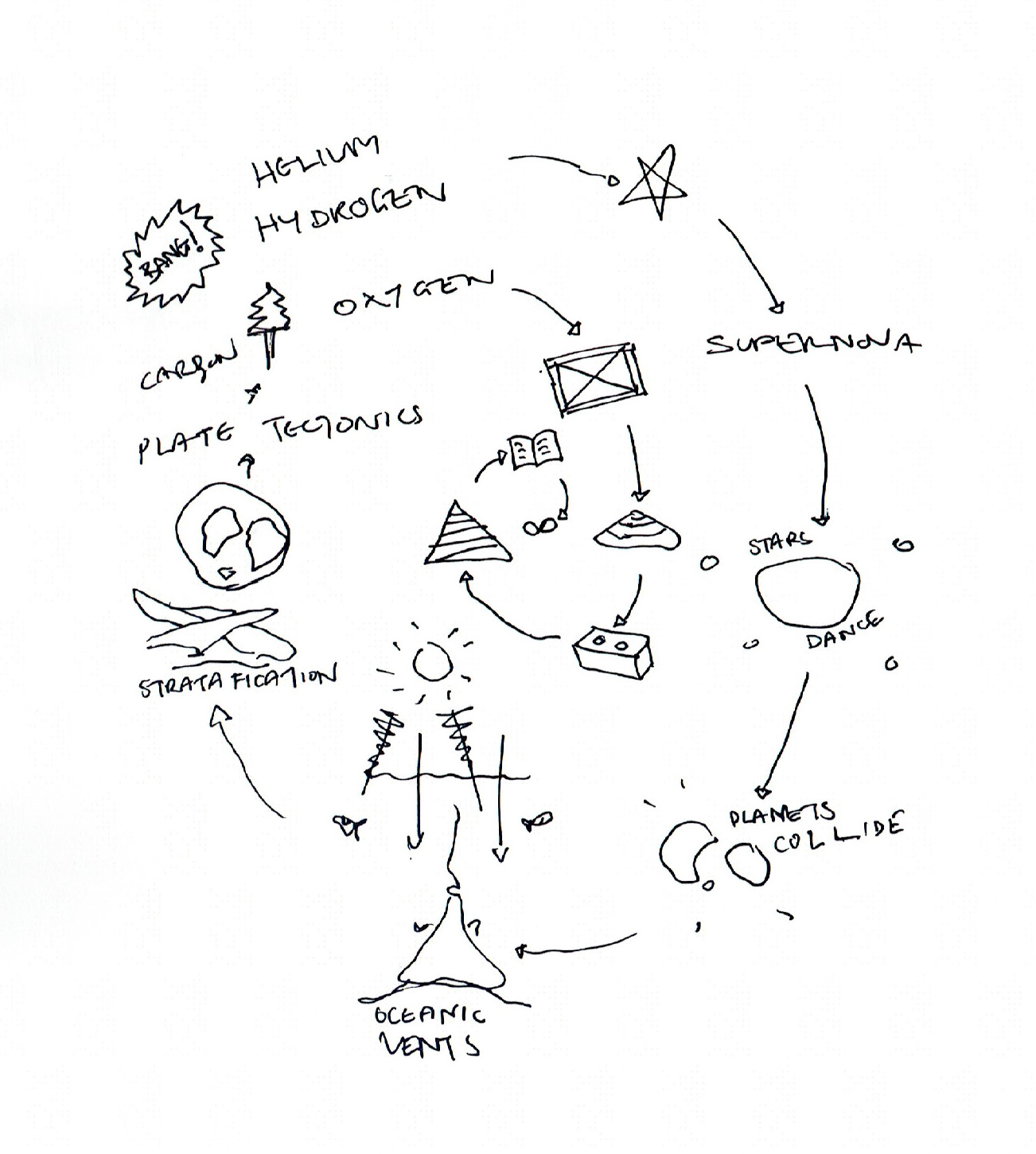
Figure 1/ Origins of Matter/ A material genealogy tracing the transformation of matter from the Big Bang through stars, planets, life, civilisation and contemporary technology. Illustrating a continuous transformation of materials across vast scales of time and space.
FROM EARTH TO ABSTRACTION
How is it, then, that we have become so divorced from material reality? What systems of representation have allowed us to articulate the world around us, and how might we develop new models that bring us closer to the material conditions from which we emerge?
Humanity has a long history of abstraction through measurement, mapping and administration. Early examples can be found in Mesopotamian land surveying, Egyptian geometry, Roman cadastral mapping and Chinese systems of territorial administration (Scott, 1998). The measurement of land, the emergence of private property and the mapping of territory all formed part of a broader process through which the world became increasingly legible, divisible and exchangeable (Scott, 1998).
The survey grid, property boundary, map, perspective drawing and, later, the architectural plan transformed the world from something directly experienced into something that could be measured, represented and controlled (Pérez-Gómez, 1983). Renaissance perspective established a singular viewpoint through which space could be organised and understood, whilst cartography, geometry and scientific measurement further transformed the world into something that could be quantified and administered (Pérez-Gómez, 1983).
These systems reached unprecedented sophistication during the twentieth century. Modernism sought to rationalise space through standardisation, geometry and universal systems of measurement. Space was flattened into plans, sections, grids and diagrams (Giedion, 1941). The Cartesian coordinate system became one of the dominant frameworks through which architects understood and constructed the world (Pérez-Gómez, 1983).
A useful parallel can be drawn between the totalising flattening of modernism and the scientific concept of the Big Bang. Just as the Big Bang can be understood as a universal zero point from which matter, space and time emerged, modernism can be understood as an architectural singularity. By flattening much of what came before it, modernism established a clean grid upon which new and increasingly complex modes of production could be layered. Modernism also opened up a world of opportunity by creating a broadly universal architectural language against which subsequent generations could either build, rebel or position themselves.
As architectural discourse expanded throughout the twentieth century, increasing attention was given to questions of symbolism, communication, image and meaning. Architecture was no longer understood solely as the organisation of space and matter, but also as a system of signs through which cultural values and identities could be communicated.
This tendency toward signification was identified by Robert Venturi, Denise Scott Brown and Steven Izenour in Learning from Las Vegas. Through the concept of the decorated shed, they revealed architecture's growing dependence upon image, symbolism and communication. The building increasingly became a carrier of information rather than a direct expression of its material and structural reality (Venturi, Scott Brown and Izenour, 1972).
In many respects, this shift paralleled broader intellectual movements emerging at the time. Structuralist and post-structuralist thinkers increasingly challenged fixed relationships between signs, meanings and reality, emphasising instead the role of representation, language and interpretation in shaping human experience (Barthes, 1977). Architecture likewise became increasingly concerned with communication, symbolism and image, further expanding the distance between material reality and its representation.
Keller Easterling extends this argument into the contemporary city. Rather than operating primarily through visible monuments or singular architectural objects, contemporary urbanisation increasingly functions through invisible infrastructures, protocols, standards and logistical systems. The forces shaping the built environment often remain hidden from view, embedded within networks that operate beyond conventional architectural representation (Easterling, 2014).
The arrival of digital technologies accelerated these tendencies and extended them into new domains. Architectural production increasingly shifted from direct engagement with materials toward engagement with representations of materials. Drawings became models. Models became simulations. Buildings could be designed, visualised and optimised long before they were physically constructed. Whilst these tools dramatically expanded architecture's capacities, they also contributed to a growing distance between representation and material reality (Carpo, 2011).
The concealment of material reality is also explored through the architectural detail. Writers such as Marco Frascari, Edward Ford and Peggy Deamer examine the relationship between construction, meaning and labour. Frascari argues that architectural details are not merely technical resolutions but sites where construction and meaning converge, describing the detail as the point at which the "telling" and the "joining" of architecture occur (Frascari, 1984). Architecture therefore communicates not only through images and symbols, but through the material articulation of its parts.
Writing on the conscious and subconscious effects of detailing, Ford argues that "the typical modern building is a constructional reality wrapped with a constructional narrative that simplifies, omits, exaggerates and often deceives" (Ford, 2011, p. 29). Ford contends that good architecture affirms scale, embraces imperfection and reveals the forces acting between its parts. Here again, the importance of relationships is foregrounded as integral to understanding material reality. Architecture is not simply a collection of objects, but a network of relationships between materials, forces, systems and people.
To foreground the systems and people inherent in construction, I believe, is essential. Notions of labour, both paid and unpaid, are often hidden from view. This again denies us access to material reality and reinforces the often-oppressive systems of production that underpin contemporary architecture. Writing in Detail Deliberations: Building (in) the Future: Recasting Labor in Architecture, Deamer argues that architectural production has become increasingly abstracted from the realities of making. Critiquing what she describes as the "perverse schizophrenia" of contemporary architectural production (Deamer, 2011, p. 84), Deamer highlights the peculiar condition of the detailer: responsible for translating architecture into buildable form whilst remaining physically and metaphorically removed from the site of production. This separation devalues the labour of architect, detailer and builder alike, producing a disenfranchised workforce stripped of agency and joy in the act of making.
Deamer's work builds upon theorists such as John Ruskin, Adolf Loos and Gottfried Semper, all of whom explored notions of craft, labour and morality within architectural production. Taken alongside Frascari and Ford, their work reinforces the argument that the expression of labour is not merely a technical concern, but an ethical one. To conceal labour is not simply to obscure how buildings are made, but to obscure the people, systems and material relationships upon which architecture ultimately depends. The concealment of reality is therefore not only a technical problem, but an ethical one.
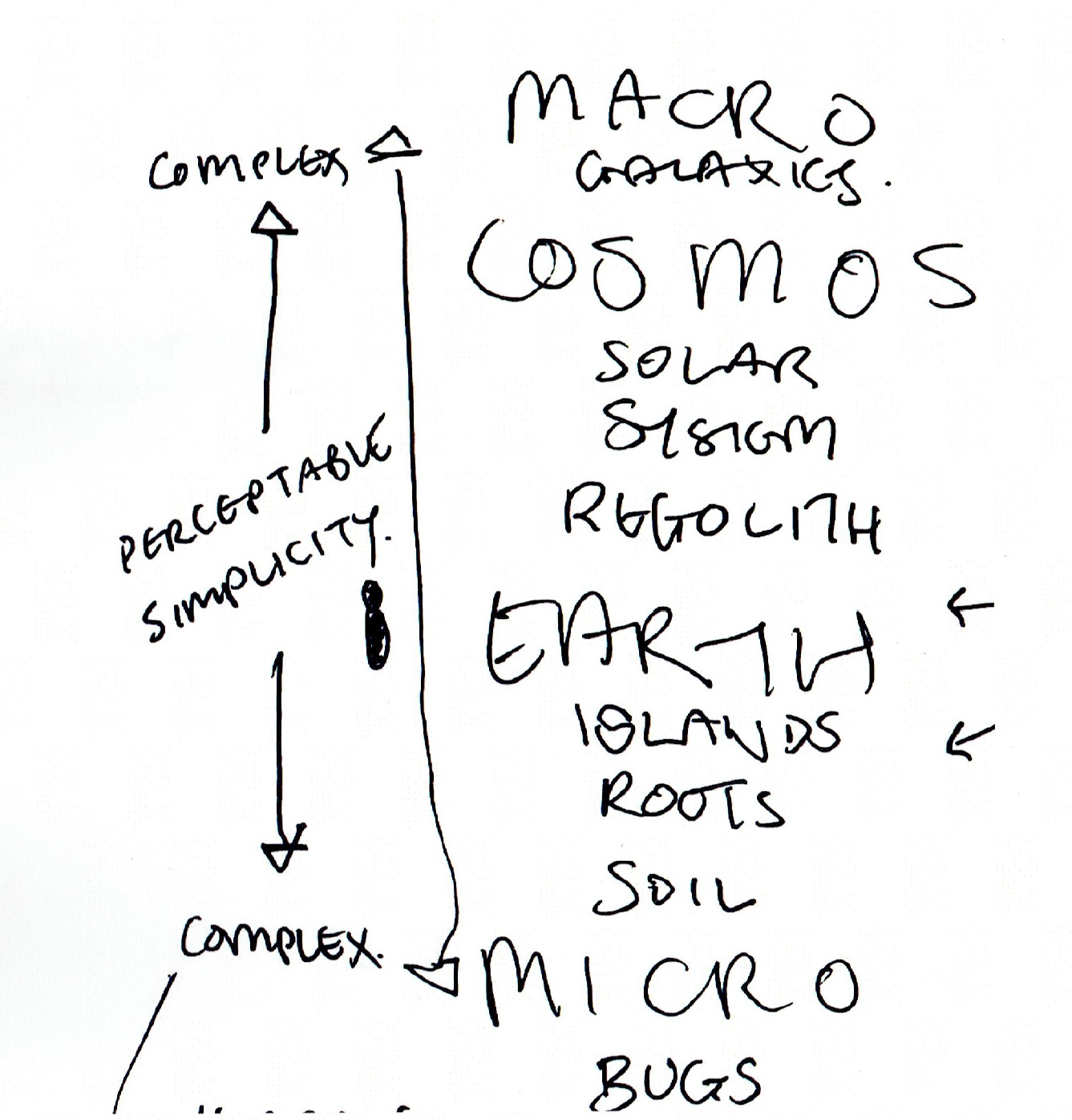
Figure 2/ The Material Continuum/ Matter exists across a series of scales extending from the cosmic down to the atomic. It is important to recognise that we, as humans, exist within, rather than outside, this continuum of materiality.
MATERIAL MEMORY AND AGENCY
If contemporary architecture too often conceals the realities of construction beneath seamless surfaces and perfected images, how might we create an architecture that is more materially grounded? I believe the answer lies in reframing our relationship with materials: giving agency back to matter and finding inspiration within the materials themselves.
The concept of material memory and humanity's role as mediator between nature and industry is explored by Irénée Scalbert in The Architect as Bricoleur. Drawing upon the work of Giuseppe Penone, Scalbert argues for a decentralised and experimental approach to architectural production. As he notes, "every object that is made in wood was once a tree" (Scalbert, 2011, p.79). Materials are therefore not inert resources awaiting human intervention, but transformed ecological processes carrying within them histories of growth, climate, landscape and time.
This role of mediator is extended through Scalbert's discussion of Robinson Crusoe, a figure situated between nature and culture. Rejecting conventional distinctions between the two, Scalbert argues that Robinson's island includes "all creation: natural forces that have been humanized, and humans like himself who became natural forces" (Scalbert, 2011, p.77). The architect is therefore positioned not as a detached author imposing order upon matter, but as a participant within larger ecological, cultural and material systems.
Scalbert concludes that bricolage is not a style but a process of engagement with the world. As he argues, "Bricolage cannot have a form because, to the bricoleur, it is a life process" (Scalbert, 2011, p.77). Rather than beginning with predetermined outcomes, the bricoleur works with existing conditions, materials and opportunities, assembling new possibilities from what is already present. Form emerges through relationships between materials, environments, labour and circumstance rather than through the pursuit of a predetermined image. Architecture should engage the world as it exists rather than impose abstract ideals upon it.
These ideas find their most developed contemporary expression within New Materialist philosophy. Whilst Scalbert and Penone approach material agency through architecture and art, contemporary theorists have attempted to construct a broader framework through which matter itself can be understood as active, relational and productive.
Thinkers such as Baruch Spinoza, Bruno Latour and Manuel DeLanda challenge the separation between matter, systems and agency. Rather than a collection of isolated objects, reality emerges through relationships, forces and material interactions. Spinoza understood nature and humanity as different expressions of a single substance (Spinoza, 2000). Latour challenged the distinction between nature and culture, arguing that reality is composed of networks of human and non-human actors (Latour, 1993). DeLanda extended this position, proposing that cities, landscapes and buildings emerge through material processes operating across multiple scales rather than fixed hierarchies (DeLanda, 2006). Together, these thinkers suggest that reality is not composed of isolated objects, but of dynamic assemblages continually shaped through interaction and exchange.
The New Materialists take this non-dualist line of thought further. Rejecting the separation of subject and object, nature and culture, they seek to address the "anthropocentric and constructivist orientations of most twentieth-century theory" and the perceived neglect of matter within Western philosophy (Gamble et al., 2019, p.111). Reality is understood not as a collection of discrete objects, but as a field of ongoing material relationships and transformations.
One of the most influential formulations of this position is Karen Barad's theory of agential realism. Barad argues that matter is not a static object awaiting human interpretation, but rather "a doing" (as cited in Gamble et al., 2019, p.112). Matter is therefore understood not as a thing, but as a process continually constituted through relationships and interactions (Gamble et al., 2019, pp.112–113).
Jane Bennett similarly argues for the vitality of matter, challenging the assumption that agency belongs exclusively to humans. In Vibrant Matter, Bennett proposes that materials possess capacities, tendencies and effects that exceed human control or intention (Bennett, 2010). Matter is not passive. It participates in the formation of events, environments and relationships.
Helen Frichot has extended many of these ideas into architectural discourse. Building upon thinkers such as Bennett and Barad, Frichot challenges anthropocentric understandings of matter and argues for a more ecological conception of architectural practice. Rather than treating dirt, landscape and material systems as passive resources awaiting extraction, Frichot encourages architects to think with matter, recognising architecture as one participant within larger ecological processes (Frichot, 2019).
Rather than positioning humans as autonomous subjects acting upon passive matter, these theorists understand humans, materials, environments and objects as participants within larger networks of becoming. Matter is not merely the substance from which architecture is made, but an active participant in its formation. New Materialism therefore offers one possible way forward: a framework that returns agency to the material world and helps us better understand our place within the constantly shifting networks of things.
If architecture has become increasingly detached from material reality through abstraction, representation and image, then material agency offers a philosophical basis for reconnecting design to the material systems from which it emerges.
ENTROPY AND ATMOSPHERE
If all matter is subject to decay, how do places acquire meaning? How do buildings move beyond mere objects to become sites of memory, atmosphere and attachment?
One of the fundamental qualities of matter is its tendency toward transformation. Given sufficient time, all materials move toward a state of entropy. On earth, this most commonly manifests through weathering, decay and erosion. Wood rots, metal rusts, stone erodes and concrete cracks. Whilst contemporary architecture often seeks to resist these processes, entropy is not an anomaly within material systems but one of their defining conditions.
Artist Robert Smithson wrote extensively on notions of time, place, entropy and identity within the contemporary landscape. In his essay A Tour of the Monuments of Passaic, New Jersey (1967), Smithson describes the industrial suburbs of New Jersey as "the opposite of the romantic ruin because the buildings don't fall into ruin after they are built but rather rise into ruin before they are built" (Smithson, 1996, p.72). These emerging suburban landscapes existed in a strange condition, seemingly detached from both history and place. Neither truly urban nor rural, they appeared suspended between construction and decay, producing a flattened vision of the future devoid of memory, identity or meaning.
Thinkers such as Walter Benjamin, Juhani Pallasmaa, Gernot Böhme and Peter Zumthor offer other possible answers. Benjamin argued that history is encountered through fragments, ruins and material traces rather than complete narratives (Benjamin, 1999). Pallasmaa suggests that materials gain richness through ageing, weathering and use, allowing architecture to register the passage of time (Pallasmaa, 2012). Böhme understands atmosphere as emerging through the interaction of material conditions, environmental qualities and human perception (Böhme, 1993), whilst Zumthor emphasises the capacity of materials, light, sound and texture to generate emotional presence and attachment (Zumthor, 2006).
Taken together, these perspectives suggest that architecture acquires meaning through its participation in time. Buildings accumulate traces of occupation, weathering and use, allowing memory and atmosphere to emerge through the material record of lived experience. Places become meaningful not when they deny time, but when they allow it to become visible.
Figure 3/ Cycles of Transformation/ Architecture is a temporary condition within larger material cycles. Construction, occupation, decay and decomposition are all stages in the ongoing transformation of matter. TDLR; Architecture is matter temporarily organised in space and time.
FUTURE DIRT
Whilst a materially truthful architecture can take us part of the way toward a greater sense of place, materiality alone is not enough. Architecture also emerges from climate, culture, labour, local knowledge and traditions of making. If atmosphere is produced through the relationship between people and matter, then the question becomes: what forms of architectural production remain grounded in the realities of place?
Thinkers such as Gottfried Semper, Marc-Antoine Laugier and Kenneth Frampton have each argued, in different ways, for an architecture grounded in construction, climate and material practice. Semper located the origins of architecture within material and craft traditions rather than abstract form (Semper, 1989). Laugier's primitive hut established nature and construction as architecture's foundational condition (Laugier, 1753/1977). Frampton's Critical Regionalism similarly sought to resist placeless globalisation through climate, culture and tectonic expression (Frampton, 1983).
Contemporary architects such as Anna Heringer, Wang Shu and Martin Rauch demonstrate that advanced architecture can remain deeply grounded in locality, craft and material expression. Their work foregrounds material intelligence, construction knowledge and the creative potential of earth-based materials whilst remaining contemporary in both ambition and execution. Rammed earth, stone construction, compressed earth blocks and bio-based materials suggest alternative paths forward. These projects are not nostalgic returns to the past, but contemporary explorations of architecture's material foundations.
Yet many of these projects still operate within largely twentieth-century tectonic traditions. Whilst they reconnect architecture to material processes, they often do so through familiar systems of representation, construction and assembly. The challenge facing architecture today is therefore not simply to recover material knowledge from the past, but to imagine new forms of practice capable of engaging the environmental, technological and social conditions of the twenty-first century.
What might an architecture look like that remains materially grounded whilst embracing emerging technologies?
Thinkers such as John Frazer, Neri Oxman and Achim Menges point toward one possible answer. Frazer proposes adaptive relationships between architecture and environmental systems (Frazer, 1995). Oxman argues that nature should be treated as a collaborator rather than a resource (Oxman, 2010). Menges demonstrates how computation can work with material behaviour rather than against it (Menges, 2012).
Parametric design, digital fabrication and artificial intelligence need not produce further abstraction. Greg Lynn's early experiments with animation and computational design challenged static conceptions of architectural form, opening the discipline to dynamic, process-based modes of thinking (Lynn, 1999). Today, these tools may allow us to better understand environmental systems, material behaviours and biological processes. Computation becomes not a mechanism of separation from nature, but a means of engaging more deeply with it.
The future of architecture may therefore lie not in increasing distance from the material world, but in recognising that technological and ecological systems are already intertwined. The task ahead is not to abandon innovation, but to redirect it toward forms of practice that remain accountable to the material realities from which all architecture ultimately emerges. The question is not whether we intervene, but when, where and how.
Figure Four/ Scales of Complexity and Intervention/ Matter exists across a continuum of increasing complexity. Good architectural practice involves choosing when and where to intervene within this larger material process.
CONCLUSION
Contemporary culture's obsession with image and surface has resulted in cities full of buildings that deny material reality and conceal evidence of labour, extraction, decay, entropy and atmosphere. When we deny ourselves access to material reality, we build a wall between ourselves and the systems that sustain us. We detach ourselves from meaning and, in turn, lose purpose and vision.
This is not only profoundly sad, but potentially dangerous in a twenty-first century context. In a world that is increasingly volatile and unpredictable, we must move towards a truly sustainable material output; not only for our physical survival, but for our collective wellbeing. Whilst architecture cannot solve all of society's problems, the buildings we inhabit shape how we understand and connect with the world around us. If we continue to produce places that deny material reality, we risk building cities, cultures and people disconnected from the ecological systems upon which they depend.
A more meaningful architecture begins not with abstraction, but with an acceptance that all things emerge from, and ultimately return to, the earth.
BIBLEOGRAPHY
Barthes, R. (1977) Image–Music–Text. London: Fontana Press.
Benjamin, W. (1999) The Arcades Project. Cambridge, MA: Harvard University Press.
Bennett, J. (2010) Vibrant Matter: A Political Ecology of Things. Durham: Duke University Press.
Böhme, G. (1993)
Carpo, M. (2011) The Alphabet and the Algorithm. Cambridge, MA: MIT Press.
Deamer, P. (2011)
DeLanda, M. (2006) A New Philosophy of Society: Assemblage Theory and Social Complexity. London: Continuum.
Easterling, K. (2014) Extrastatecraft: The Power of Infrastructure Space. London: Verso.
Ford, E. (2011) The Architectural Detail. New York: Princeton Architectural Press.
Frazer, J. (1995) An Evolutionary Architecture. London: Architectural Association.
Frampton, K. (1983) 'Towards a Critical Regionalism: Six Points for an Architecture of Resistance', in Foster, H. (ed.) The Anti-Aesthetic. Seattle: Bay Press.
Frichot, H. (2019) Dirty Theory: Troubling Architecture. Edinburgh: Edinburgh University Press.
Gamble, C.N., Hanan, J.S. and Nail, T. (2019) What is New Materialism? Minneapolis: University of Minnesota Press.
Harari, Y.N. (2014) Sapiens: A Brief History of Humankind. London: Harvill Secker.
Hawking, S. (1988) A Brief History of Time. London: Bantam.
Ingold, T. (2013) Making: Anthropology, Archaeology, Art and Architecture. London: Routledge.
Latour, B. (1993) We Have Never Been Modern. Cambridge, MA: Harvard University Press.
Laugier, M.-A. (1977) An Essay on Architecture. Los Angeles: Hennessey & Ingalls.
Lynn, G. (1999) Animate Form. New York: Princeton Architectural Press.
Menges, A. (2012)
Mumford, L. (1961) The City in History. New York: Harcourt Brace.
NASA (n.d.)
Oxman, N. (2010)
Pallasmaa, J. (2012) The Eyes of the Skin: Architecture and the Senses. 3rd edn. Chichester: Wiley.
Pérez-Gómez, A. (1983) Architecture and the Crisis of Modern Science. Cambridge, MA: MIT Press.
Sagan, C. (1980) Cosmos. New York: Random House.
Scalbert, I. (2011)
Scott, J.C. (1998) Seeing Like a State. New Haven: Yale University Press.
Semper, G. (1989) The Four Elements of Architecture and Other Writings. Cambridge: Cambridge University Press.
Sennett, R. (2008) The Craftsman. New Haven: Yale University Press.
Smithson, R. (1996) Robert Smithson: The Collected Writings. Berkeley: University of California Press.
Spinoza, B. (2000) Ethics.
Venturi, R., Scott Brown, D. and Izenour, S. (1972) Le
arning from Las Vegas. Cambridge, MA: MIT Press.
Zumthor, P. (2006) Atmospheres. Basel: Birkhäuser.


CLICK THE BOOK BELOW TO DOWNLOAD